
The system
A building produced
like a product.
Production lines, specialised workstations, repetition, working in the dry, industrialised quality control. The craft site becomes an industrial activity — closer to the car industry than to bricklaying.
In the workshop
Five minutes inside our production lines.
Steel folding, window production, assembly of the building assemblies, erection on site. Filmed at our premises and at our partners'.
Three pillars
Why industrialisation changes the outcome.
-
Industrialise to make reliable
Traditional construction is subject to the weather, the labour shortage, fragmented subcontracting and rework. Producing offsite removes those four causes at the root rather than managing them.
-
Digitalise the whole cycle
A Digital Twin carries the project from design to production and then to assembly. Engineering, manufacturing and execution can no longer diverge: they read the same model.
-
Create a structural advantage
Intelligent standardisation of components, controlled cadence, reduced site time. The gap in cost and lead time does not come from a commercial discount: it comes from the process.
The path of a project
From your drawings to your site.
-
Feasibility study
You send us the drawings. We check what the structure will take, what the permit allows, and we reply within a few days.
-
Design in Digital Twin
The building is modelled in full before a single profile is cut. Dimensions, areas, openings and interfaces are frozen at this stage.
-
Workshop production
Frames, building assemblies and windows come off our lines in Belgium, in the dry, under control. More than 60 % of the building is produced before the site opens.
-
Quality control
Every element is checked as it leaves the workshop — not discovered on a scaffold six months later.
-
Assembly on site
The site becomes an assembly operation: short, clean, plannable, and far less exposed to the weather.
The workshop
Belgium.
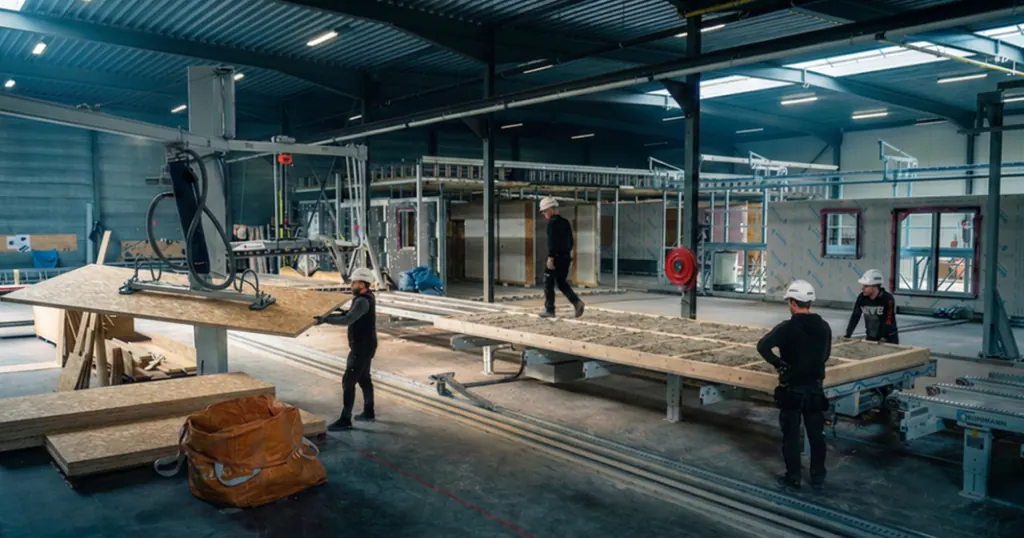
Automated wall production unit, integrated window line, and a capacity of 80 to 120 units per year on a single shift.
On productivity, let us be precise
The McKinsey & Company and World Economic Forum analyses of industrialised construction converge: productivity per worker is of the order of two to three times higher than that observed in traditional residential construction.
That is a productivity measure, not a promise of speed. What it implies for you: fewer labour hours, hence a lower cost; a controlled cadence, hence lead times that hold; standardised production, hence consistent quality.